
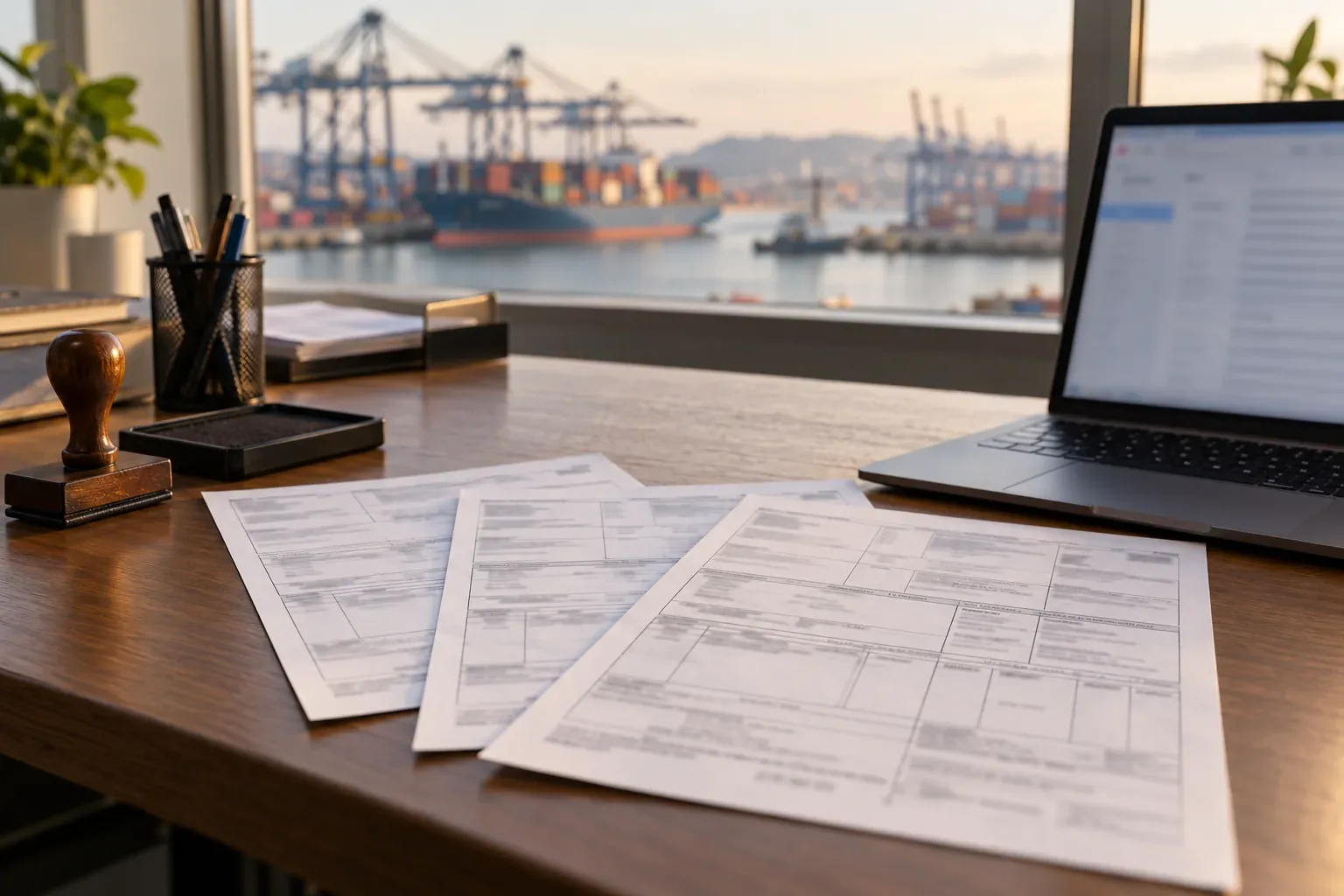
What is a telex release, and when will a line issue one?
What a telex release is, how it differs from an original bill of lading, a sea waybill and express release, what a line needs before it issues one, and what the destination agent checks.
What a telex release is
A telex release is the message that lets cargo be released at the discharge port without the original bills of lading, because the full set has already been surrendered somewhere else, usually at the port of loading. ITIC's Guidelines for the Release of Cargoes, from an insurer of ship agents, call it "the surrender of the original b/l at one port (usually the load port) and release of the cargo at another port". The bill is still an original; only the place where it is handed back changes. The name has outlived the machine: an ITIC article from 2007 notes that the release is almost always made by email today.
Why shippers and lines use it
Under a bill of lading, the carrier delivers against the paper. The Hamburg Rules of 1978 define it as a document "by which the carrier undertakes to deliver the goods against surrender of the document". That works until the paper is slower than the ship. Maersk's guide to cargo release calls telex release useful "when the original B/L won't arrive with the shipment on time", and its FAQ on surrendering a bill gives one case: the shipper surrenders the bill once the consignee has paid the commercial invoice, which avoids courier delays and mishandled documents.
The cost is risk. The same guide says a telex release "carries a higher risk since the physical B/L is not presented", and ITIC says careless telex releases continue to cause numerous misrelease claims.
How it differs from an original bill, a sea waybill and express release
- Original bill of lading. The UNCTAD secretariat's report on transport documents explains that under a negotiable bill the goods are released at the port of discharge only against surrender, so holding it amounts to constructive possession of the goods. A "to order" bill can pass along a chain of buyers or be pledged to a bank; see shipper, consignee and notify party.
- Telex release. The same original bill, surrendered at origin; the release instruction travels instead of the paper.
- Sea waybill. A non-negotiable receipt and evidence of the contract of carriage that, in UNCTAD's words, "need not be presented in order to obtain delivery". ITIC says the agent's duty is normally limited to checking the identity of the named consignee. Maersk's online surrender service "does not apply to Waybills".
- Express release. A loose term. Maersk's 2021 notice on its electronic cargo release service says it is "also known as 'Telex' or 'Express' release", while ITIC describes express bills surrendered at the load port so that cargo can be released without the original, for example between branches of one company. Ask which one is meant.
Electronic cargo release is Maersk's name for surrendering online. Its FAQ says the service is open only to customers that have signed its Web BL printing agreement, and only the bill's owner can request it once the original has been issued online.
What has to happen before a line issues one
ITIC starts with the principal: lines often set out a telex release procedure in their agency manual, and where there is none, the Releasing Agent needs the line's written authority every time. The agent who takes in the originals, which ITIC calls the Authorising Agent, must then:
- Obtain the full set of original bills, properly endorsed where the bill is "to order".
- Collect all outstanding freight and charges payable at that port.
- Get written instruction from the shipper, or a valid endorsee, naming the port of release and the receiver in full.
- Send the Releasing Agent a clear message confirming the surrender and the charges, with the B/L number, date and place of issue, containers, cargo and receiver.
Why the full set? ITIC notes that bills "are usually issued in a set of three originals", so more than one party could hold one. The Hamburg Rules require a bill to state the number of originals if more than one is issued, and the Rotterdam Rules say that surrender of one original suffices and the others cease to have any effect or validity. The Rotterdam Rules are not in force (UNCITRAL's status page showed 5 parties on 27 October 2026, against the 20 needed), so both conventions are quoted for their wording, not as the law of any particular bill. If one original can be enough to take delivery, a release against two of three leaves the third in someone's hands.
Lines add their own conditions. For its online release, Maersk's guide asks among other things that the bill is negotiable and not already surrendered, and that electronic release is permitted at the place of delivery. The service is charged, at a rate that depends on the bill owner's country, as published in Maersk's FAQ and read on 27 October 2026.
The risks: the wrong receiver and the forged email
ITIC's 2007 article names two problems. The first is loose wording. After a line agreed to send a Singapore shipper's cargo on from the UK to Durban, the load-port agent emailed the UK agent: "Shipper has confirmed COD charges and bills are now surrendered. Please kindly go ahead, Thanks." A clerk took "go ahead" as permission to release the cargo to the original consignee without the bills. The cargo was misreleased, and the claim ran from the shipper to the line to the agents.
The second is fraud: emails faked to look as if the load-port agent sent them, confirming originals collected and freight paid when they were not. ITIC reports containers of mobile phones misdelivered and a large freight bill left unpaid.
ITIC's guidelines say the carrier has a duty to collect the original bills before releasing cargo, that delivery to a party not holding an original is a breach of the bill of lading contract for which the legal holder can sue, and that a letter of indemnity does not remove that liability but only gives a claim against whoever signed it (as published by ITIC, read on 27 October 2026).
What the destination agent checks before the delivery order
The Releasing Agent, who issues the delivery order, makes the last check. From ITIC's guidelines:
- Confirm the principal has authorised telex release, and follow any extra requirement it sets, such as letters of indemnity.
- Read the message. It must confirm that the full set of originals, endorsed where needed, has been collected, that load-port freight and charges are paid, and give the cargo, containers and the receiver's full name and address.
- Do not press Reply. Email the Authorising Agent at a genuine address you have checked yourself, paste in the message, and ask them to confirm they sent it.
- Check the manifest for later instructions not to release, or to release to someone else, and whether any charges are still due.
ITIC's words after the email check: only then should the Releasing Agent issue the delivery order. At the counter, Maersk's 2022 notice for the UK describes release "upon proof of identity of the receiver as consignee".
How AVISA records a telex release
In AVISA, each booking has one bill of lading, issued as an original in a set of three. When the shipper surrenders the originals, your team presses Issue Telex Release on the booking and confirms. AVISA stamps the date, time and user itself, so a release cannot be back-dated; pressing it twice changes nothing, and it cannot be undone.
From then on the bill of lading is locked: staff can no longer edit its delivery agent or issue date, or reissue it, while a manager still can. The telex release print, with TELEX RELEASED across every sheet, is produced only after the release is recorded, on the same pre-printed stationery layouts as the bill of lading; one line's form is measured so far, and another line's is added as development work. Your team sends the telex to the destination office. Checking an incoming telex with its sender, as ITIC advises, stays with your team.
The delivery order has its own check. AVISA refuses it until the booking's invoices are settled, or while none exists, and the consignee comes from the booking. A manager can release it anyway, but only by ticking Release without settlement on the form. The rest is on shipping documents in AVISA.
Frequently asked questions
What is a telex release bill of lading?
It is an original bill of lading whose full set has been handed back at origin, usually the load port, so the cargo can be released at destination against a message instead of the paper. It is still called a telex release, though the message is almost always an email today.
What is the difference between OBL and telex release?
With an original bill (OBL), the receiver hands an original to the carrier's agent at destination to take delivery. With a telex release, the originals were handed in at origin, and the destination agent releases against the confirmation it received. The document is the same; the place of surrender is not.
What is the difference between a sea waybill and a telex release?
A sea waybill is not a document of title and does not have to be presented, so the agent mainly checks that the person collecting is the named consignee. A telex release starts from an original bill, which, if made out to order, can be sold or pledged until it is surrendered. ITIC notes that even under a waybill an unpaid shipper may tell the carrier not to release, and the carrier cannot ignore that instruction.
What does "bill of lading surrendered" mean?
It means the originals have been handed back to the carrier or its agent before the cargo is delivered, usually at the port of loading. One Maersk office's procedure calls it a "Surrender (Telex) B/L". ITIC advises that the surrendered originals be stamped accomplished once the cargo is released and kept on the voyage file.
Why 3 original bills of lading?
A set of three is usual practice; the conventions quoted above ask only that the bill state how many originals were issued. Because one original can be enough to claim the cargo, a telex release needs the whole set surrendered, not one or two.
Ask for a demo of AVISA

Amirh. Safavi
Founder of BudTech
Amirh. Safavi is the founder of BudTech LLC, the IT and software company in Muscat that makes AVISA.
More from Amirh. Safavi